On this side of the Pacific, the news is less encouraging. What follows is another Washington leak to OFK, one which must remain without attribution. My source is extremely well-placed to comment on the matters of which he informs me. I wish I could say how well placed.
Why, some of us want to know, has the North Korean Human Rights Act lodged in the State Department’s windpipe? Why, over a year after the bill was signed into law, does an executive agency that’s nominally answerable to the President of the United States fail to accept North Korean refugees who knock at the embassy gates? I specifically cite Section 303 of the North Korean Human Rights Act of 2004, which is now binding law:
The Secretary of State shall undertake to facilitate the submission of applications under section 207 of the Immigration and Nationality Act [meaning, asylum applications] (8 U.S.C. 1157) by citizens of North Korea seeking protection as refugees (as defined in section 101(a)(42) of such Act (8 U.S.C. 1101(a)(42)).
In plain English, that means that our embassies violate federal law if they fail to “facilitate” asylum applications at our embassies abroad. Yet Tim Peters not only informs me that our embassies are refusing to take these refugees, he’s said the same to Congress under oath, and he has it on film, thanks to CNN. One overseas ambassador, so another source tells me, went so far as to seek legal advice from Foggy Bottom as to how to interpret the law. He was told in no uncertain terms not to ask again.
What do I conclude? State is doing its damnedest not to comply with the law. Who in this administration has the juice to make that happen? Somewhere, a Keyzer Soze must be at work.
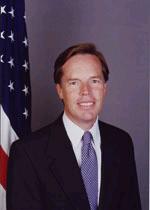
My source tells me that Keyzer Soze is one Nicholas Burns, a career State Department official who held a prominent role–State Department spokesman–during the Clinton Administration. Burns, my source tells me, wants to get us to Agreed Framework II, which is the diplomatic equivalant of wanting to make Gigli II. Here is some info from Burns’s official bio:
Ambassador R. Nicholas Burns is the Under Secretary of State for Political Affairs, the Department of State’s third ranking official. Appointed by President Bush, he was confirmed by the U.S. Senate on March 17, 2005 and was sworn into office by Secretary of State Condoleezza Rice. As Under Secretary, he oversees U.S. policy in each region of the world and serves in the senior career Foreign Service position at the Department.
Prior to his current assignment, Ambassador Burns was the United States Permanent Representative to the North Atlantic Treaty Organization. As Ambassador to NATO, he headed the combined State-Defense Department U.S. Mission to NATO at a time when the Alliance committed to new missions in Iraq,
Afghanistan and the global war against terrorism, and accepted seven new members.From 1997 to 2001, Ambassador Burns was U.S. Ambassador to Greece. During his tenure as Ambassador, the U.S. expanded its military and law enforcement cooperation with Greece, strengthened our partnership in the Balkans, increased trade and investment and people-to-people programs.
From 1995 to 1997, Ambassador Burns was Spokesman of the Department of State and Acting Assistant Secretary for Public Affairs for Secretary of State Warren Christopher and Secretary Madeleine Albright. In this position, he gave daily press conferences on U.S. foreign policy issues, accompanied both Secretaries of State on all their foreign trips and coordinated all of the Department’s public outreach programs.
Mr. Burns, a career Senior Foreign Service Officer, served for five years (1990-1995) on the National Security Council staff at the White House. He was Special Assistant to President Clinton and Senior Director for Russia, Ukraine, and Eurasia Affairs. He had lead responsibility in the White House for advising the President on all aspects of U.S. relations with the fifteen countries of the former Soviet Union.
Under President George H.W. Bush, he was Director for Soviet (and then Russian) Affairs. During this time, he attended all U.S. ““ Soviet summits and numerous other international meetings and specialized on economic assistance issues, U.S. ties with Russia and Ukraine, and relations with the Baltic countries. He was a member of the Department’s Transition Team in 1988, and served as Staff Officer in the Department’s Operations Center and Secretariat in 1987-1988.
My source says that Burns doesn’t want our State Department taking any actions that would unduly offend Kim Jong Il, such as taking in refugees, or letting any pesky part-time Special Envoy muck it all up with unpleasant remarks about investigating infanticides, concentration camps, or gas chambers. Hence, we hear relatively little from Lefkowitz, and shouldn’t expect to hear much more of consequence. Just to be sure–according to a different source–State has placed individuals sympathetic to the Burns world view in Lefkowitz’s office . . . to better keep him inside the range of his electronic ankle bracelet.
Congress is impatient about the progress of legislation it supported overwhelmingly. That overwhelming–make that unanimous–support certainly includes some strong proponents of “engagement,” whatever that means–Tom Lantos and Jim Leach, to name two. This should not be a political issue, but it has become one.
Whether Nick Burns is the Keyzer Soze of this plot is a matter beyond my personal knowledge, but my source harbored no doubts and volunteered the information. My own research adds nothing to either discredit or support what my source tells me, and frankly, given that Burns’s primary function in recent years has been to toe the official line, I’m unsurprised by that. You can’t be a very effective spokesman if your personal views are public knowledge.
If this is in fact true, what really astonishes me the most? That five years into this presidency, we still have a quasi-Clinton State Department, one so dedicated to the discredited policies of the previous administration that it’s willing to flout a federal statute to get us there.
NKHRA Progress Report: Who Is Keyzer Soze?
[…] The Friday event, at the Washington Omni Shoreham, was by invitation only. My friend, a very experienced news correspondent, forwards these notes in exchange for a promise of anonymity. I edited slightly for spelling and grammar: Bolton sounded fine, convincing enough, on the need for UN reform. I kept waiting for mention of N. Korea, thought it might be coming when he touched on Iran, but no. Wonder whether it was deliberate – [the Administration] or State Dept saying, “Don’t tread on that sensitive topic when we’re trying to get six-party talks restarted while also dealing with counterfeit issue.” That’s consistent with what I’ve heard before. It’s hard to top “hellish nightmare,” my best efforts to encourage it notwithstanding. Amb. Bolton certainly had something to do with this resolution, but he hasn’t been vocal on the North Korea issue during his tenure. One hopes that will change before much more time passes. […]
NKHRA Progress Report: Who Is Keyzer Soze?
[…] Here. Thanks, Doug. We’ll be watching that page carefully. It means, as predicted here before, that Congress’s patience with the State Department’s dithering on NKHRA implementation is about exhausted. Here is an excerpt of Rep. Leach’s statements at last October’s hearings: The response to our questions at that hearing indicated that the United States had not yet undertaken the high level diplomatic efforts with third countries necessary to allow us to proceed with the quiet process of saving even some limited number of intending refugees. […]
NKHRA Progress Report: Who Is Keyzer Soze?
[…] My instinctive reaction was that this the latest retreat by a hopelessly divided and indecisive Administration that has steadily given ground to an intransigent North Korea. The retreats have been punctuated by words and occasional actions meant to create the appearance of decisiveness, but this report seals the continuity of those retreats fairly seamlessly since the Clinton Administration. Whereas our former position had been to work toward diplomatic recognition “eventually,” with non-specific discussions about human rights being a “soft” precondition, there’s really no saying if and how the issue would ever have been a part of the U.S. agenda. I personally believe that the State Department establishment has never met an agreement it didn’t like and is desperate to have this one before we enter the next presidential election cycle. That simple explanation is probably the most likely, and David Sanger’s NYT story notes that this is indeed the doing of Condi Rice and Philip Zelikow. Sanger, by the way, seems to have good connections in the White House. His information is generally accurate. […]
NKHRA Progress Report: Who Is Keyzer Soze?
[…] This a gratuitous distortion. No, there is little to no chance that diplomacy will strip North Korea of its nukes or its missiles. This was just as true, and just as obvious, after eight years of diplomacy by Perry’s colleagues Warren Christopher, Madeleine Halfbright, and half the combined payroll of Brookings and the Council on Foreign Relations. When it comes to diplomacy with North Korea, everyone has failed. That tends to be the result when you’re slow to pick up on the fact that you’re negotiating with someone who’s only playing and stalling you. Perry’s colleagues spent eight years bribing and toasting a tyrant whose disregard for human life should have made the difference between his will and our perceptions completely clear to everyone, including George W. Bush. Unfortunately, Bush did little more than fine-tune the Clinton approach for most of his tenure. He even used many of the same people (Jack Pritchard and Nicholas Burns, to name two) to do it. Publicly, at least, the Administration still thinks it can negotiate North Korea’s disarmament: “We think diplomacy is the right answer, and that is what we are pursuing,” [National Security Advisor Stephen Hadley] said when asked about Mr. Perry’s recommendation in an opinion column published today in The Washington Post. […]
NKHRA Progress Report: Who Is Keyzer Soze?
[…] Funding the North Korean Human Rights Act: Incredibly, several key provisions of this legislation remain unfunded or underfunded, in large part due to foot-dragging at the highest levels of the U.S. State Department. Most significant among these are the lack of new funds for radio broadcasting or delivery into North Korea. The United States could also decide to fund grants authorized under Section 203, for organizations promoting the human rights of North Koreans who are outside North Korea. […]
NKHRA Progress Report: Who Is Keyzer Soze?
[…] Oddly enough, providing radios and broadcasting to the North Korean people is authorized by U.S. law — the Sections 103 and 104 of the North Korean Human Rights Act of 2004. Unfortunately, the State Department, eager not to upset the atmosphere of negotiations in which it invests great hope, has used its influence to stall the appropriation of the funds and the implementation of the Act. And those negotiations? The parties haven’t met since Kim Jong Il renounced an initial, vague, tentative agreement last September. […]
NKHRA Progress Report: Who Is Keyzer Soze?
[…] The Korea Liberator on various possible U.S. responses to the missiles[link contains analysis for other countries as well: Funding the North Korean Human Rights Act: Incredibly, several key provisions of this legislation remain unfunded or underfunded, in large part due to foot-dragging at the highest levels of the U.S. State Department. Most significant among these are the lack of new funds for radio broadcasting or delivery into North Korea. The United States could also decide to fund grants authorized under Section 203, for organizations promoting the human rights of North Koreans who are outside North Korea. […]
[…] Its policy was, in other words, a slightly less gullible extension of the policy Clinton pursued for eight years, beginning when North Korea probably lacked nuclear weapons, and which his party would still be pursuing to this day.  The Bush and Clinton policies even share a key architect, who has remained in a high State Department position through both administrations.  If only our national debate were better served, with better criticism. At a minimum, it ought to come from someone other than those who failed so miserably at stopping North Korea from going nuclear in the first place. […]
[…] At least he isn’t going to the State Department. But I suspect that Condi Rice and Nicholas Burns will find common ground with him. It’s not good news. […]
[…] When Lefkowitz ties the regime’s income from the slavery of its subjects to its WMD programs, he swims from the margins of U.S. policy into its mainstream, which has mostly washed human rights concerns aside until now. Lefkowitz is now making a direct connection between North Korea’s human rights abuses and the enforcement of U.N. resolutions aimed directly at its WMD programs. That will strike some as a corruption of something beautiful and pure, to which they might also add “functionally useless.” I disagree with them, as do others who actually matter. Section 101 of the North Korean Human Rights Act, enacted unanimously by the Congress, calls on the Administration to make human rights an issue in its talks with North Korea.  The connection Lefkowitz makes is also consistent with the Jackson-Vanik philosophy of tying economic benefits to tangible progress on human rights, and that approach continues to have strong supporters in both parties. My own view is that transparency – or more accurately, North Korea’s resistance against it – is the common root of every problem the world has with North Korea, including these two. If North Korea won’t open its books, why should we think it will ever open its reactors and underground laboratories, or let us speak freely with those who work there? […]
[…] Of North Korea’s intentions and attitudes, we already know plenty from past experience. The real question is what our own government is willing to do for a few friendly headlines. I think personalities in the State Department who would overlook inspection, verification, and proliferation to please their Chinese and South Korean friends have the tiller firmly in their grasp. Bush is worn down from bleeding wounds to his ankles, going through the motions, taking the path of least resistance, and getting ready to pop smoke. If his true goal was to show the futility of dealing with liars, he certainly took great pains to miss a perfect opportunity to do that. Here is the dirty little secret of Bush’s foreign policy: aside from the elephantine exception of Iraq, it has been remarkably similar to Bill Clinton’s. […]
[…] Our diplomats have forgotten that their job is to preserve peace, not just to make deals. Our next Republican president should learn that lesson well and begin his term of office by doing what Bush failed to do: purge the senior ranks at State. […]